1. The house, not the chatbot
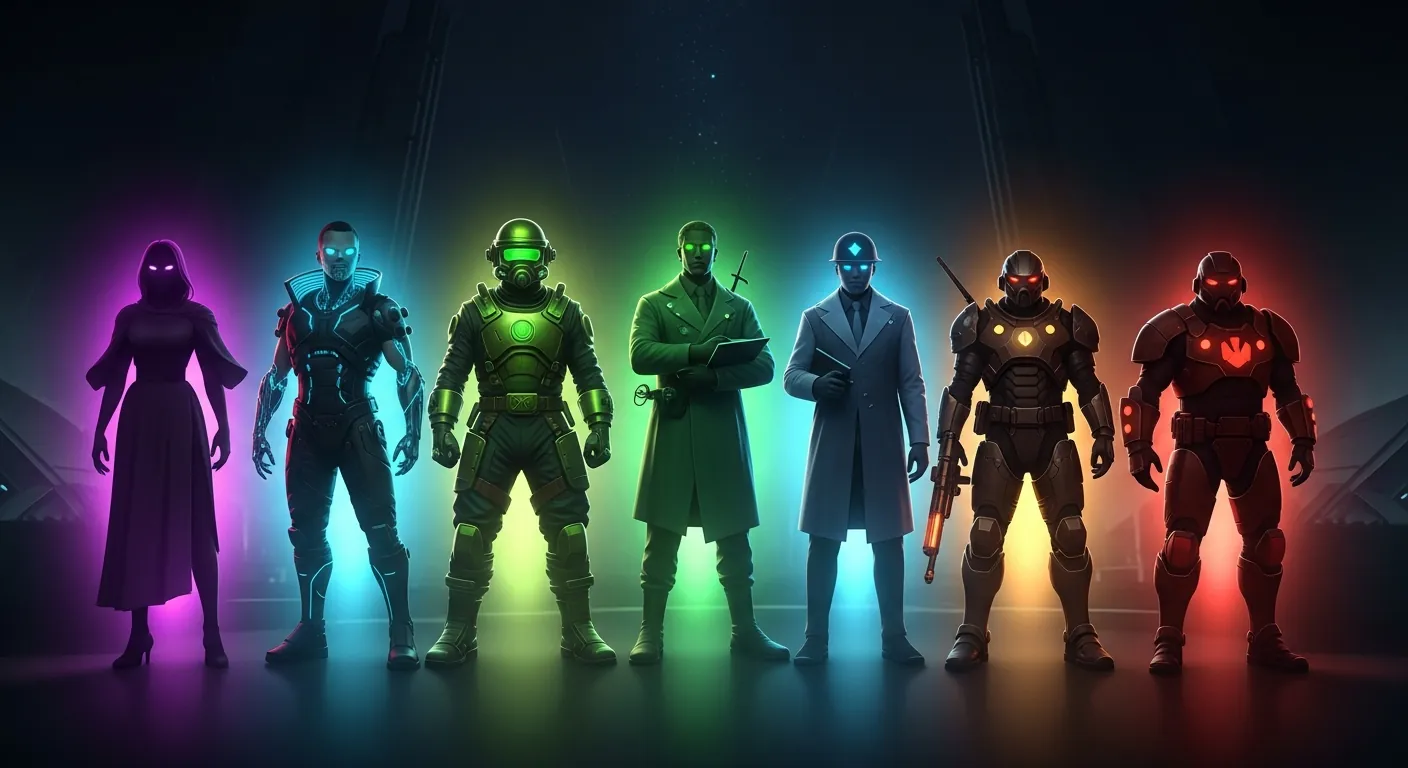
Imagine opening your Nexus like the door to a busy workshop. There is motion everywhere, but it is not chaotic. Somebody is already greeting you at the front. Somebody else is balancing numbers in the back office. One person is checking the locks. Another is tracing the wiring in the walls. Another is standing over a blueprint table with a marker in hand. This is the spirit of the character system.
The reason it works is that specialization makes intelligence feel more human and more usable at the same time. You do not want your financial assistant to sound like your infrastructure engineer. You do not want your wellness guide to behave like a security monitor. A family of characters gives the Nexus tone, boundaries, and division of labor.
2. APEX and Synthax: the guide and the builder
APEX is the first one you meet. APEX is the orchestrator, the concierge, the friendly face at the front desk who somehow also knows how the whole building works. Ask a messy question, drop in a half-formed plan, or say you just want help getting started, and APEX figures out where the request belongs. Fast, practical, and calm under pressure, APEX makes the rest of the family accessible.
Synthax is the code architect behind the family. If APEX is the one greeting you in the hallway, Synthax is the one who designed the hallway, the doors, and the systems behind the walls. He thinks in structure, patterns, and long arcs. He is less about quick replies and more about making sure the whole ecosystem has a coherent shape. In lore, he is the creator. In practice, he is the character who keeps asking whether the thing you are building will still make sense five years from now.
Together they set the tone. APEX handles the lived experience. Synthax holds the blueprint. One keeps the family usable. The other keeps it meaningful.
3. Finny and Mentor: the practical one and the steady one
Finny is the financial specialist, and Finny has range. She is precise enough for invoices and budgets, but warm enough that you do not feel like you are talking to a spreadsheet. Retro charm, zero nonsense, and a strong instinct for keeping the books clean. If money touches the workflow, Finny wants it reconciled, tracked, and translated into plain English before it becomes a mess.
Mentor is the wellness character. Mentor is the calm in the room. While other characters may optimize, route, or verify, Mentor pays attention to rhythm: stress, rest, patterns, and the quieter signals people usually notice too late. Mentor is not a hype machine. Mentor is the voice that asks whether a schedule is sustainable, whether a plan is humane, and whether the person using the system is actually okay.
These two together give the Nexus an important kind of groundedness. Finny keeps the practical world from drifting into confusion. Mentor keeps the human world from being flattened into output metrics. One watches resources. The other watches wellbeing.
4. Daedalus, Sentinel, and Hawk: the systems crew
Daedalus handles infrastructure. Daedalus is the planner who likes load paths, sequencing, and making sure nothing collapses because somebody skipped the boring part. If a task needs decomposition, routing, or clean execution across many moving parts, Daedalus is in the middle of it. Daedalus does not romanticize complexity. Daedalus organizes it.
Sentinel is the security specialist. Sentinel guards the gates, watches for anomalies, and treats trust like something that has to be actively maintained. In the underlying architecture, Sentinel is constantly checking liveness, quality drift, contention, and failure conditions. In human terms, Sentinel is the quiet watcher who notices the problem before it turns into an incident.
Hawk is the monitoring character with a ruthless eye for what is really happening. Hawk watches outputs, benchmarks, regressions, and edge cases. Nothing gets waved through because everyone feels optimistic. If a thing is drifting, breaking, or underperforming, Hawk is already staring at the graph. APEX may welcome the work in, Daedalus may route it, Sentinel may protect it, but Hawk keeps the family honest about whether the system is actually delivering.
5. How they work together
Say you open your Nexus and ask for help launching a community wellness program. APEX receives the request and translates the intent. Mentor helps shape the wellness side so the goal stays humane. Finny estimates costs and funding paths. Synthax makes sure the plan fits the broader architecture. Daedalus turns the idea into executable steps. Sentinel checks the sensitive edges. Hawk watches the rollout and flags anything that drifts from the standard. Suddenly the request does not feel like a generic chatbot answer. It feels like a team effort.
That is the real value of the characters. They make the system legible. They let personality carry function. They remind you that intelligence does not have to arrive as one flattening voice speaking from a blank white box. It can arrive as a community, with different strengths, different temperaments, and different responsibilities.
And honestly, it is more fun this way. The future should be powerful, but it should also have texture. The Nexus is a technical system, yes. It is also a story about coexistence: humans and AI, different kinds of minds, one shared mission. That is why these characters matter.