Civic Compute
What if your city ran its own computing infrastructure — and shared the value with every citizen?
Today, your city builds roads, runs libraries, and maintains parks. In this concept, it could also run AI infrastructure — and return the value of that computing power to the people who live there.
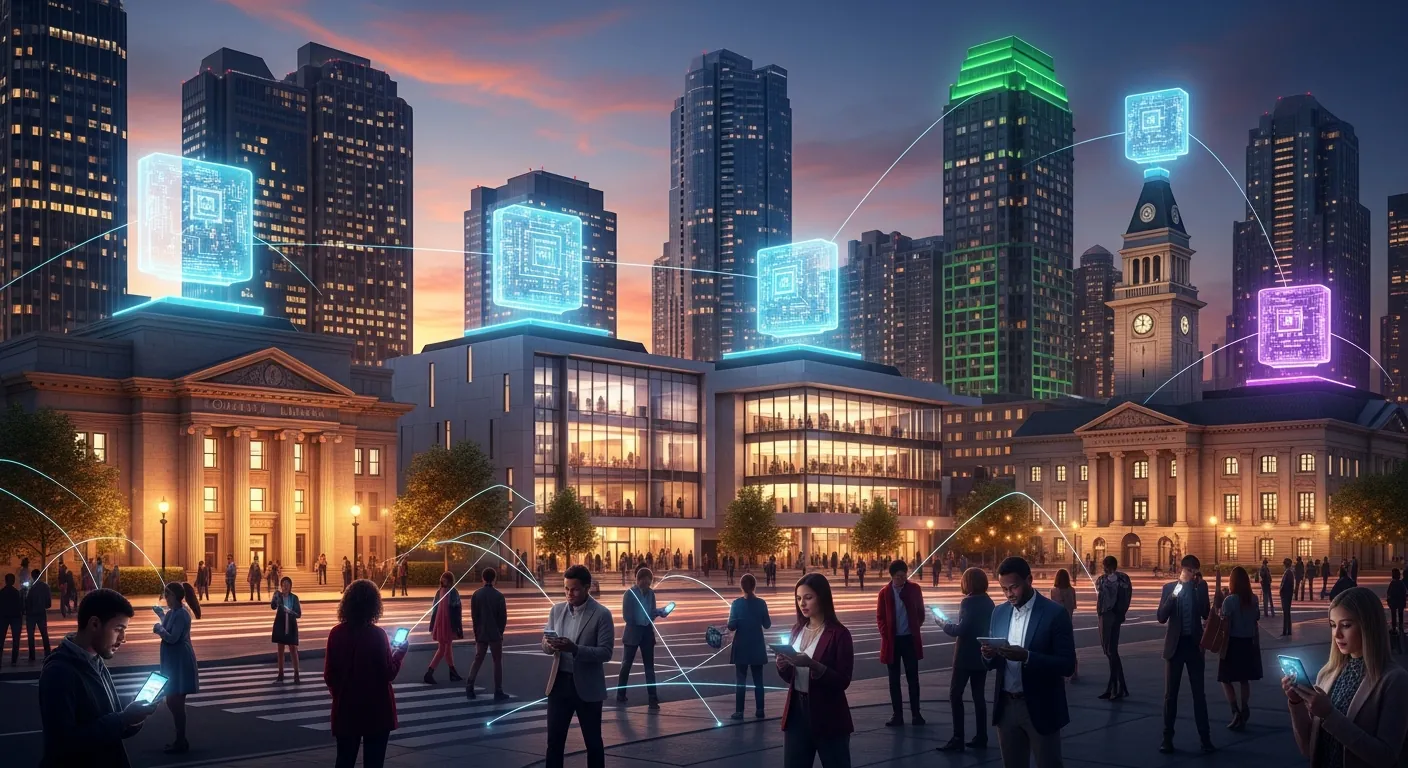
From public buildings to public value
Civic Compute turns underutilized space in public facilities into productive AI infrastructure. The process is straightforward, and the benefits flow directly to residents.
A city deploys compute nodes
GPU-equipped hardware is installed in libraries, community centers, schools, and municipal data centers. The same buildings that already serve the public now serve the network.
Nodes join the One People network
The hardware begins processing AI inference, training specialist models, and executing Commons Jobs. Every cycle of work is verified through proof-of-useful-work.
A concept for civic AI
The proposal would use verified compute contributions to cultivate shared intelligence on approved civic hardware, subject to public procurement, privacy, security, and governance rules that have not been designed or adopted.
Citizens receive AI tools
AI tools are distributed to residents or reinvested into local public services. Citizens use them for AI health, legal, education, and creative work.
AI services that serve the people
When a city owns its own computing infrastructure, it can build services tailored to the real needs of its residents — without handing data to corporations or paying per-query fees to distant cloud providers.
Community health analytics
Run health models on local data without it ever leaving the city's infrastructure. Track public health trends, allocate resources, and deliver AI-powered wellness tools to clinics and residents — all privacy-first.
Local education platforms
AI tutors that understand local curriculum. Language learning tools for immigrant communities. Homework help that runs on city hardware and costs nothing for families to access. Education without a subscription fee.
Municipal AI services
Permit processing, transit optimization, infrastructure monitoring, public records search. The routine work of city government, accelerated by AI that the city owns and controls — no vendor lock-in.
Emergency response
When disaster strikes, centralized cloud fails. Local compute nodes keep working. Real-time coordination, resource allocation, and communication tools that function when the internet goes dark.
Every citizen benefits
The proposal is that approved civic hardware could help train AI tools for residents. No city deployment or public-benefit distribution is represented as operating today.
This is not a welfare program or a speculative investment. It is the natural return on a public asset. The city built the infrastructure. The infrastructure does useful work. The people who funded it share in the intelligence it creates.
Universal basic compute
Citizens receive AI tools from their city's contribution, giving everyone — regardless of income — access to AI services for health, education, legal help, and creative work. The digital divide narrows when computing is a public utility.
The city deploys 200 Standard-tier nodes across public libraries and community centers. The nodes perform AI inference and specialist training, cultivating shared intelligence for the community.
Half the resulting AI tools are distributed to residents as a civic compute benefit. The other half funds civic Commons Jobs: transit optimization, public health analytics, environmental monitoring.
Citizens use their AI tools for tutoring, health consultations, and creative work. The value stays local. The data stays local. The infrastructure belongs to the people.
Public infrastructure for the digital age
A century ago, cities built power grids and water systems. They created parks and public libraries. These investments defined what it meant to be a citizen. Civic Compute is the next chapter in that story.
Sovereignty, not dependency
When a city runs its own compute, it does not depend on Big Tech for AI services. Data stays within city boundaries. Decisions about infrastructure are made by elected officials and residents — not corporate boards.
Local economic multiplier
Shared intelligence cultivated by a city's nodes circulates in the local economy. Residents use it for services, creators build with it, and local businesses benefit. Value generated locally stays local.
Resilience when it counts
Centralized cloud fails during the moments communities need it most — natural disasters, infrastructure outages, emergencies. Local compute keeps working when everything else goes dark.
Parks gave us shared green space. Libraries gave us shared knowledge. Civic Compute gives us shared intelligence — AI infrastructure that belongs to the public and returns its value to the public.
This is not a future that requires permission from a tech company. Any city, any community, any neighborhood can start building today.
Shape the future of Civic Compute
The design of Civic Compute is being developed in the open. Join the Commons to propose ideas, challenge assumptions, and help build public computing infrastructure that actually works for people.