Universal Hardware
Every device cultivates intelligence.
Your laptop, phone, old desktop, or gaming rig could eventually help train AI expert models through a federated, private, local contributor network. This is the intended design; the network and its guarantees must be verified before launch.
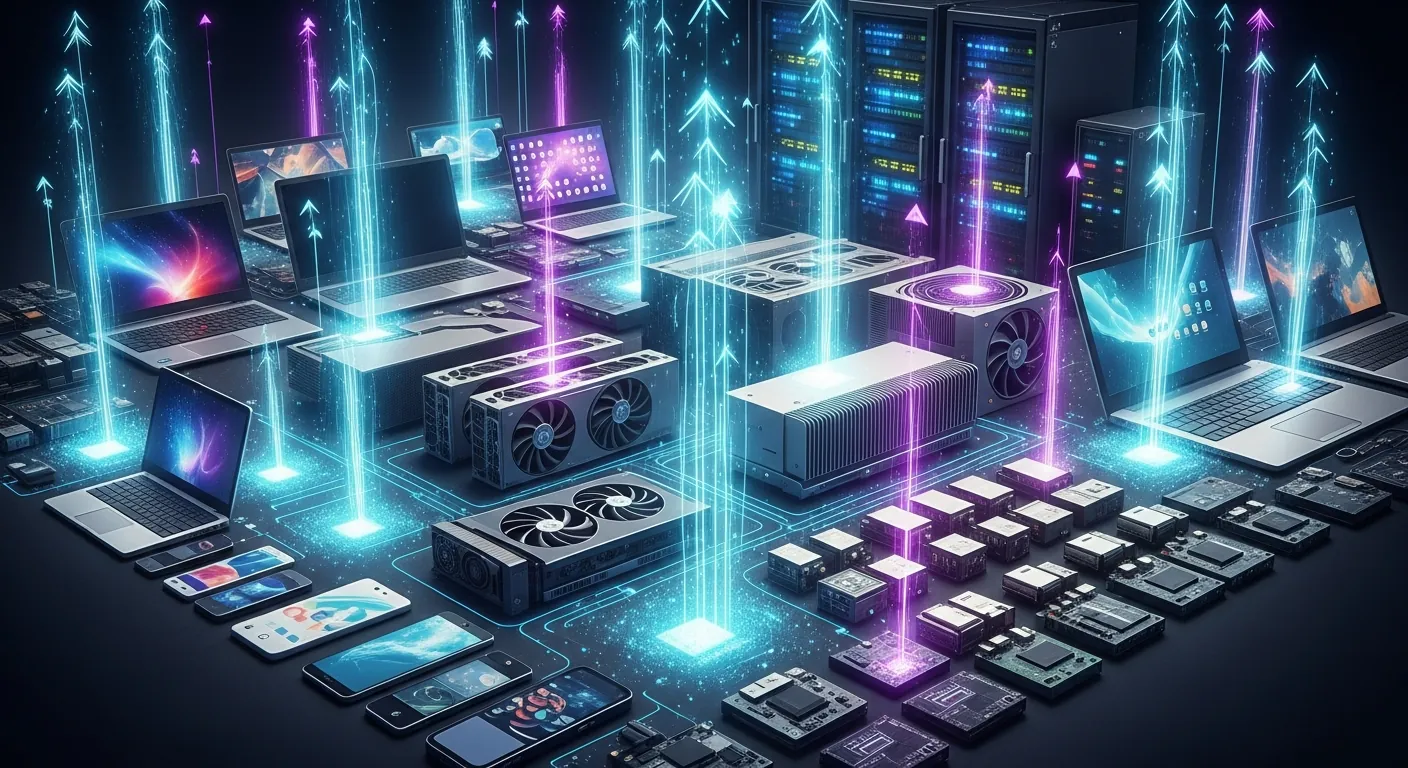
Four proposed capability tiers.
The design assigns eligible devices to tiers based on capability rather than price. Final eligibility, contribution, and benefit rules would require technical validation and further design.
The spark
Small but mighty. Lite Beacons handle focused specialist training — quick expert LoRA updates, small task inference, edge processing. Perfect for devices you already carry everywhere.
- Smartphones (iOS and Android)
- Tablets
- Raspberry Pi 5
- Older laptops
The backbone
Most of the cooperative lives here. Standard Beacons run medium-sized training runs and inference — real conversations, document analysis, code assistance, and creative work.
- Modern laptops and desktops
- Apple M1 / M2 Macs
- Gaming laptops
- Entry-level workstations
The workhorse
Pro Beacons push into large model territory. Complex reasoning training, long-form generation, multi-step analysis, and regular heavy training runs. The hardware enthusiasts and creators live here.
- Gaming PCs with RTX 3090 / 4090
- Apple M2 Ultra / M4 Max
- Professional workstations
- High-memory desktops
The forge
Ultra Beacons are the training clusters of the cooperative. They run the largest open models, participate in distributed training, and forge new experts that the whole community receives. In the future, they may serve as edge hosts for their neighborhoods.
- Multi-GPU rigs
- AMD Strix Halo workstations
- Server-grade hardware
- Dedicated compute nodes
It just figures it out.
When you install the One People node software, a hardware scanner runs automatically. It discovers what your device can do, benchmarks it in under 20 seconds, and assigns a tier. No forms to fill out. No specs to look up. No technical knowledge required.
Discovery
The scanner detects your CPU, GPU, memory, and available storage using safe, user-space methods. It works on Linux, macOS, and Windows. It never needs administrator access and never collects serial numbers, MAC addresses, or any hardware fingerprints.
Benchmark
A quick, local inference test — roughly 15 seconds — measures your device’s actual AI performance. No downloads, no cloud calls. Just a small bundled model that runs on whatever you have, from CPU-only laptops to multi-GPU rigs.
Tier assignment
The scanner combines your hardware profile with the benchmark result to assign a tier: Lite, Standard, Pro, or Ultra. You can set limits too — for example, only contribute Lite capacity during the day and Standard at night.
Ready to contribute
Under the proposed model, a Beacon would publish limited capabilities to the network and receive eligible tasks that match the device. Participation rules are yet to be designed, and participation would not create ownership or legal membership by itself.
The hardware scanner is a capability detector, not a fingerprinting tool. It identifies what your device can do without identifying your device. No serial numbers. No MAC addresses. No hardware fingerprints.
It supports every major GPU family — NVIDIA (CUDA), AMD (ROCm), Intel (OneAPI), and Apple Silicon (Metal) — and detects trusted execution environments for sensitive workloads like health data, without ever overstating what the hardware can actually do.
No gatekeeping. Everyone contributes.
Most distributed computing networks set a high bar. You need expensive hardware, technical expertise, and a willingness to jump through hoops. One People does the opposite. If your device can do useful work, it belongs.
No minimum specs
A Raspberry Pi running small specialist training is a real contributor, not a second-class citizen. The cooperative values every Beacon for what it brings. A thousand Lite Beacons covering a city is more valuable than one Ultra Beacon in a data center on the other side of the world.
Your hardware, your terms
You decide when to contribute and how much. Cap your tier during work hours. Go full capacity overnight. Pause anytime. The cooperative adapts to your life, not the other way around. You stay in control of your own machine.
Real intelligence from idle compute
Billions of devices sit idle for part of the day. The One People proposal explores using some of that capacity for approved AI training and community tools while preserving user control.
When the lights go out, your neighborhood still has answers.
Imagine a blackout. The internet is down. The data centers are silent. But your neighborhood still has intelligence — because the Beacon in your home is still serving AI to the people around you. Medicine, education, and truth, running on your hardware, for your community.
Edge serving — the future
In a future phase, eligible hardware could support local inference as well as training. Sensitive civic or health uses would require separate security, privacy, legal, and governance approval before deployment.
Gated on privacy
Edge serving only unlocks when we solve the privacy puzzle together. We're building a model where your hardware serves your community without exposing your data or theirs. When it's ready, members who opt in can become lighthouses for their neighborhoods.
Civic resilience
This is the deeper promise: a community that can think for itself, even when the rest of the world goes dark. Not a node in a network. A guardian of your community. The last line of defense against centralized failure.
The future of computing is not a data center in someone else's country. It is the device in your hand, the laptop on your desk, and the old tower in your closet — all cultivating intelligence together, for all peoples.