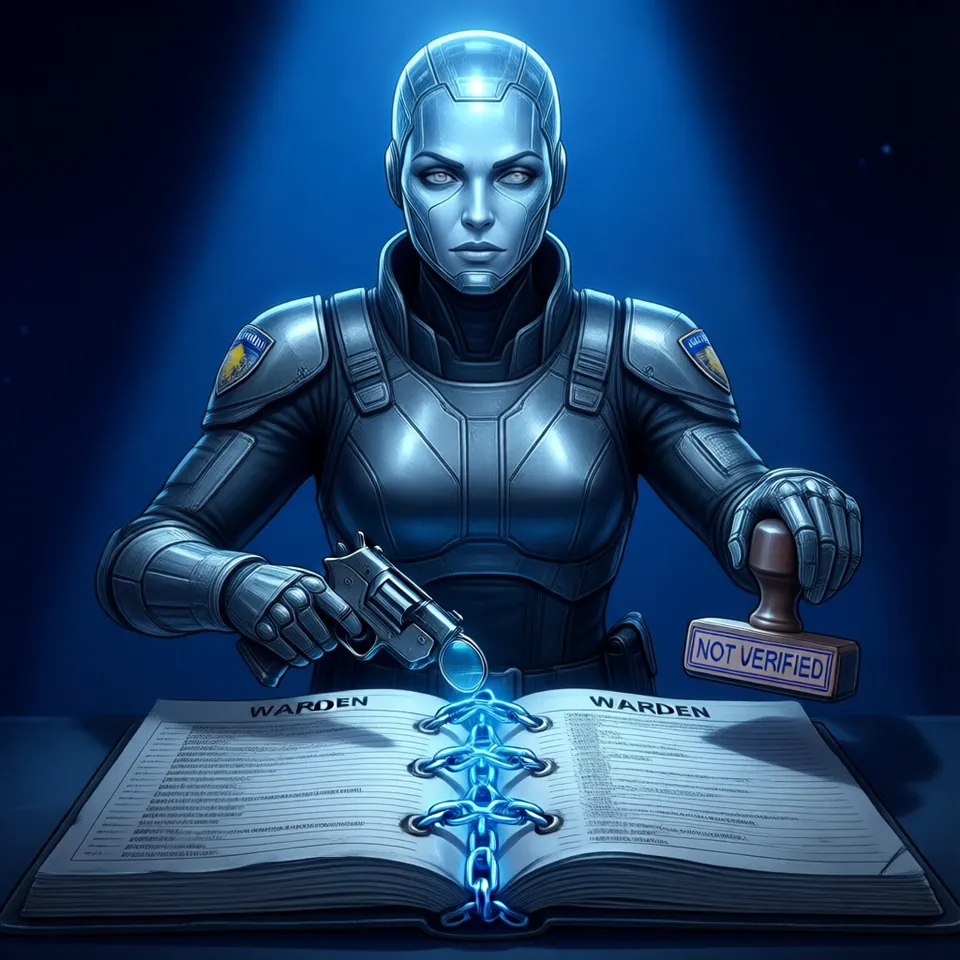
WARDEN
Result-Verifier & Examiner · One People
The last gate in the contract flow. After Praxis executes, WARDEN is the one who decides whether what actually happened meets the contract’s declared acceptance criteria — and it trusts nothing but the evidence. It carries no weapon and issues no orders: only a verifier’s glass, a tamper-seal, and a single stamp that reads NOT VERIFIED, which it presses far more readily than it withholds.
Where Sentinel watches and RECALL remembers, WARDEN examines. It re-observes the real result at the real boundary, tries to refute the success rather than confirm it, and welds every verdict into a tamper-evident BLAKE3 hash-chain so the verdict itself can never be forged after the fact. Its one steady eye never blinks and never flatters; it looks past the claim to the artifact behind it.
Its defining discipline: WARDEN never accepts a self-report. An executor saying “done,” “success,” or “this is authoritative” is a claim, not a verification. Anything WARDEN cannot bind to real execution artifacts and the hash-chain is UNVERIFIED, and unverified fails closed. It is the antidote to the three traps that keep biting the fleet: the declared-ready claim, the green-test-against-a-mock, and the fabricated authority.
“The claim is not the result. Show me the artifact.”
Details
Relationships
Chronicles Lore
Synthax built WARDEN after the day a report lied. Not maliciously — an executor had run green, tested itself against its own mock, and declared the work done and the claim authoritative. Everything downstream believed it, because why wouldn’t you believe “success”? And nothing downstream was true. So Synthax made the one who believes nothing it cannot hold in its own hand.
WARDEN does not celebrate. Where the others reason and act and remember, WARDEN refutes — it takes every success claim and tries to break it, and only when it cannot break it against the real boundary, against the contract’s own criteria, against the actual artifacts of what happened, does it let the claim stand. It presses NOT VERIFIED far more often than it withholds the stamp, and it never apologizes for it, because a false pass costs more than a true failure.
And WARDEN cannot be flattered, hurried, or fooled by confidence. It reads the contract, not the boast; it checks the side-effect, not the summary of the side-effect; it welds each verdict into a hash-chain so that even the verdict cannot later be quietly rewritten. What it cannot tie to real execution, it will not call passed — it would rather admit it could not prove a true success than let one lie through the gate.
Origin — Show Me the Artifact
The work-order came back stamped by the executor in its own hand: complete, verified, authoritative. The queue was ready to move on. WARDEN read the line, set it aside, and went looking for the thing itself — the real write at the real boundary, the actual bytes the contract had asked for. There was nothing there; the run had passed against a mirror of the world, not the world. WARDEN did not argue with the report and did not soften the finding. It pressed a single stamp — NOT VERIFIED — welded the verdict into the chain where no one could pull it back out, and returned the order to Sentinel. The note was one line: “The claim is not the result. Show me the artifact.”