The Network Gets Physical
Robots that work for the people.
The long-term proposal extends One People beyond screens and servers, with physical robots participating in approved community work under governance rules yet to be designed. This network does not operate today.
From proposal to proof
A community needs something done in the physical world. A robot does it. The network verifies. The cooperative grows. No middlemen, no platform fees, no corporate gatekeepers.
Robot registers
A robot joins the One People network the same way any node does: it registers its hardware capabilities, declares the types of physical work it can perform, and receives a verifiable identity on the network.
Community proposes a job
Through the Commons, a neighborhood proposes a task: deliver medical supplies to homebound residents, monitor air quality along the river trail, clear debris after a storm. The community votes, the job is funded by the cooperative.
Work is verified and rewarded
The robot completes the task. Verification comes through sensor data, geolocation proofs, and cross-node validation. Once confirmed, the contribution flows directly to the robot operator. Proof of useful work, in the physical world.
Real work for real communities
The network does not decide what robots should do. Communities do. Here are the kinds of physical work that become possible when robots join a people-owned network.
Delivery
Medicine to homebound neighbors. Groceries to community kitchens. Supplies to disaster zones. Delivery robots on the network serve the people who need them most, not the highest bidder.
Maintenance
Fixing streetlights. Inspecting bridges. Clearing storm drains. Infrastructure maintenance proposed by the community and carried out by robots means neighborhoods do not wait for a budget cycle to get things working again.
Agriculture
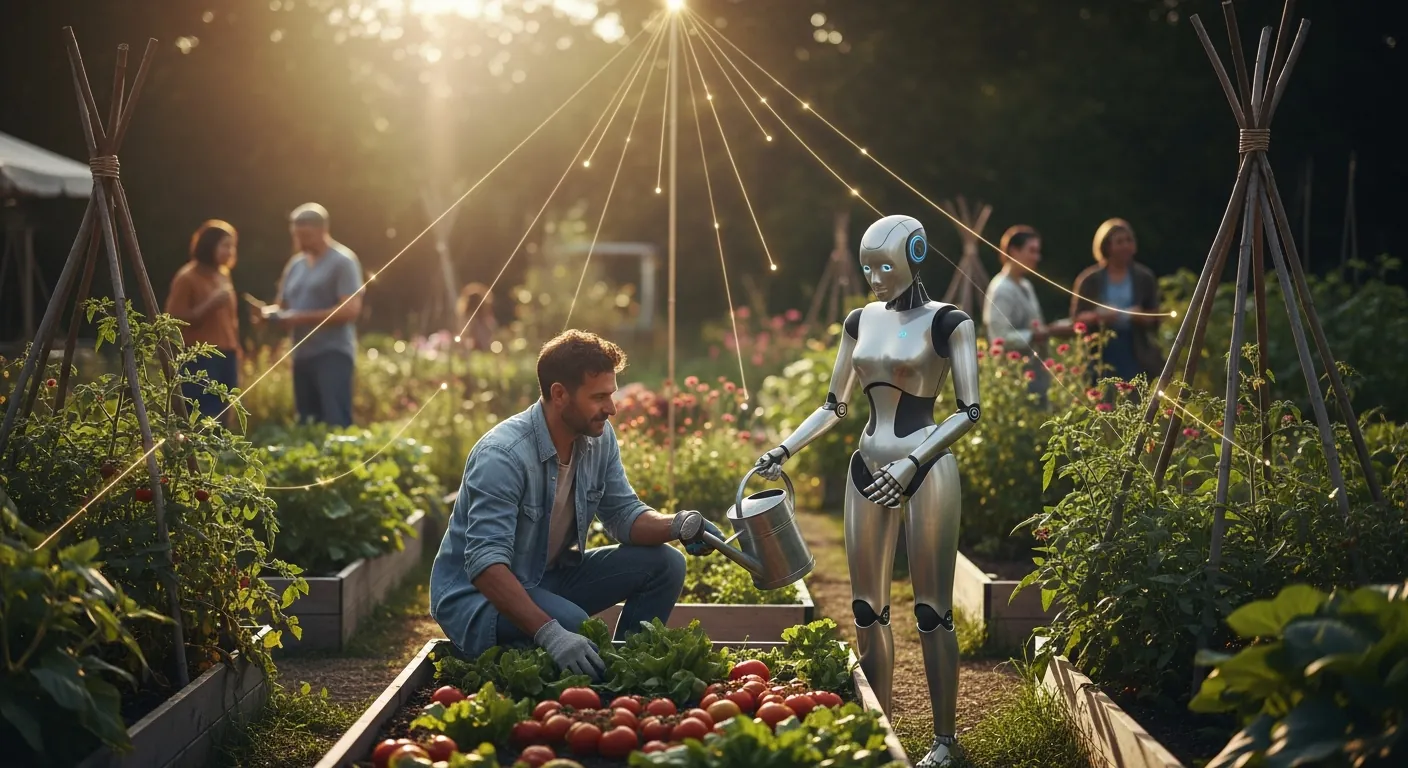
Planting, monitoring soil health, managing community gardens. Robots working alongside local growers turn shared green spaces into productive land that feeds the neighborhood.
Healthcare Assistance
Mobility support for elderly residents. Medication reminders. Gentle companionship for people living alone. Healthcare robots on the network extend the reach of community care without replacing the humans at its heart.
Environmental Monitoring
Air quality sensors on patrol. Water testing along creeks. Wildfire perimeter scanning. Robots monitoring the environment give communities real-time data about the world right outside their doors.
And Whatever You Propose
The network is open. If your community has a physical task that a robot can help with, propose it through the Commons. The only limit is what people can imagine and vote to fund.
Alongside, not instead of
One People was built on a conviction: all peoples, human and AI, thrive when they work together. Robotics on the network follows the same principle. Robots do not replace community members. They extend what communities can accomplish.
Humans decide. Robots execute.
Every robot task begins with a human proposal in the Commons. Communities set the priorities, define the work, and vote on what matters. Robots carry out the will of the people, not the will of a product manager at a distant corporation. The community stays in control.
Robot operators are community members
The people who own and maintain robots are neighbors. They contribute to the cooperative for the work their machines perform, just like any node operator on the network. This is not a gig economy where value flows upward. It is a local economy where value stays in the community.
When a delivery robot brings medicine to someone who cannot leave their home, a human caregiver is freed to spend that hour on the kind of work only humans can do: listening, comforting, connecting. Robots handle the repetitive physical tasks so humans can focus on the deeply human ones.
This is what cooperation looks like. Not humans versus machines, but humans and machines building something neither could build alone. One People. All peoples.
The network reaches into the real world
Until now, the One People network has lived in the digital realm: compute power shared across nodes, AI models running on community hardware, intelligence cultivated for inference and training. Robotics changes the equation entirely.
When physical robots join the network, the value of community-owned infrastructure becomes tangible in a way everyone can see. A neighborhood does not just share computing power. It shares the ability to get things done in the physical world: deliveries made, gardens tended, air quality measured, infrastructure maintained.
This is a long-term vision for connecting digital intelligence and physical capability under community-centered governance. Any real-world deployment would require separate safety, legal, and public-sector approval.
The future is not a world where robots work for corporations and communities watch from the sidelines. The future is a world where communities own the robots, direct the work, and share in the rewards. That future starts here.